|
TERRITORIES & HOME RANGES
-
Activity Patterns in Urban Environments
-
Home Ranges and Territories
-
Solitary vs. Pack Coyotes
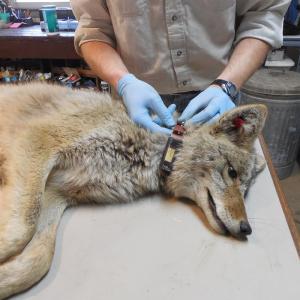
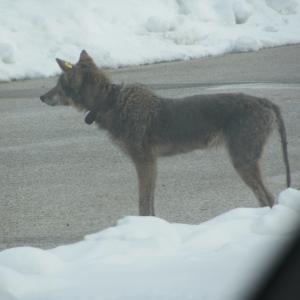
Radio-collars allow us
to identify the location of coyotes throughout the
day.
Coyote locations are recorded as coordinates and
entered into a Geographic Information System (GIS)
in order to determine the activity patterns, home
ranges, territories, and habitat selection of
coyotes.
ACTIVITY PATTERNS IN URBAN ENVIRONMENTS
We have found that
coyotes in the Chicago metropolitan area confine
most of their activity to nocturnal hours, which has
been observed by virtually all studies of urban
coyotes, whereas in natural areas, coyotes tend to
be diurnal (active during the day) or crepuscular
(active at dawn and dusk).
The activity patterns of
coyotes depend upon many environmental and
individual factors, such as the availability of
prey, avoidance of predation or human-related
activities, and life-history strategies, such as
hunting strategies and social organization.

Fig. 1.-- Patterns of activity for radio collared coyotes
in the
Chicago
metropolitan area from 2000 to 2002. Bars
represent the proportion of
locations in which a coyote was
active per hour of
radio telemetry. Dots/lines
represent the number of locations
recorded per hour.
Switching to nocturnal
activity patterns in urban areas may be an adaptive
response that allows coyotes to minimize contact
with humans, reducing risks associated with
encounters while still allowing them to exploit the
environment.
However, coyotes are likely to individually
vary in their responses to human activity even
within the same population.
Coyote responses to
people may depend upon the degree to which coyotes
can habituate to humans or find shelter from them.
HOME RANGES & TERRITORIES
Home ranges
are the areas used by animals to meet their daily
needs and may overlap with home ranges of neighbors.
Home range size can be an important indicator
of habitat quality or the distribution of resources.
Territories
are also home ranges except that they are defended
from other individuals and do not overlap.
In the case of coyotes, groups (or packs)
defend their territories from other groups, whereas
solitary coyotes do not defend their home ranges.
Other studies have also found that territory
sizes of coyotes decrease with increased
urbanization given adequate food is available. In
general, studies have found that urban coyotes tend
to have smaller territories than rural coyotes.
Many coyote territories are associated with large
parks or forest preserves, which provide an
abundance of cover and food.
In these cases, the boundaries of territories
will often follow the park boundaries.
However, much to our surprise, other coyotes have
been able to establish territories and form packs
without the benefit of large blocks of habitats.
This formation of packs and territories can
even occur in downtown areas, if parks or natural
areas exist in scattered, small patches. In some
cases, these are coyotes that have created
territories in residential areas or complexes of
small parks and golf courses.
In either case, coyotes manage to defend these
territories so that the territories have very little
overlap, which controls their density and spatial
arrangement across the landscape. This is frequently
called a land-tenure system. We still have much to
learn about how coyotes maintain packs in downtown
areas. See
Featured
Territories for examples of how
some coyotes live in downtown
Chicago
and suburban areas.
Figure 2 shows the territorial boundary of different
packs across 260 square miles, an area encompassing
at least 12 cities.

Fig. 2.--
Distribution of coyote packs during 2004. The
area of the map encompasses at
least 12 cities over 260 square
miles. Each color represents the
home range of an alpha
male or female that represents
the territorial boundary for the
pack. Some territories are fragmented as a
result of the computer model
used to estimate the boundaries,
but it
is obvious that territories have only limited overlap.
SOLITARY VS. PACK COYOTES
Home-Range Size:
Radio-tracking revealed two different types of
movement patterns among coyotes in Cook County, and
these differences were related to social behavior-
whether a coyote was associated with a pack (Pack
Coyotes) or not (Solitary Coyotes).
·
Pack coyotes,
also known as resident coyotes, are those that
belong to pack.
Coyotes in a pack share a territory, which
they defend together.
In Cook County, we have found that pack
coyotes have smaller territories than solitary
coyotes, averaging less than 2 square miles (4.95
km2) but as large as 4.3 square miles (11.1km2).
·
Solitary coyotes,
also known as transient coyotes, are those coyotes
that do not yet belong to a pack and therefore do
not have a territory that they defend.
In
Cook
County, solitary coyotes
range over much larger areas and have home ranges
averaging 10 square miles (26.8 km2).
Unlike home ranges of residents, we have
found that home ranges of transients were not
composed exclusively within natural fragments,
although natural land cover was still the most used
land-cover type (see The Study for a map of
land-cover types in the Chicago metropolitan
area).

Fig. 3.--
Distribution of coyote home ranges during 2004.
Light green lines represent the
home ranges of solitary coyotes,
while the smaller colored areas
represent the territorial
boundaries of packs (as seen in
the previous figure). O’Hare International Airport is located in the lower right
corner. The large home ranges of
solitary coyotes overlap
territories of packs as well as
home ranges of other solitary individuals.
As the Cook County Coyote Project has progressed, we
have been able to follow individual coyotes as they
change from solitary coyotes with large movement
patterns to social groups with small territories
(and vice versa). In some cases, these are coyotes
that have created territories in residential areas
or complexes of small parks and golf courses.
Approximately 50 percent of the coyotes
radio-collared as subadults (one to two years of
age) or adults have been solitary for at least a
portion of the study.
The home ranges of solitary coyotes span large areas of the metropolitan
area, and they overlap extensively with pack
territories as well as other solitary coyotes.
Solitary coyotes use a wide variety of habitats and can be found in
virtually any part of the metropolitan area, even in
downtown areas. We have observed some solitary
coyotes finding mates and establishing their own
territories, whereas others eventually disperse and
leave the area permanently. In a few cases, resident
adult coyotes have left their territories after the
death of a mate.
Given the large areas
traversed by coyotes and the number of roads coyotes
regularly cross during their activities, it is not
surprising that vehicles are the most common cause
of death. Some of the roads crossed by coyotes in
our study have average traffic volumes of more than
100,000 vehicles every 24 hours.
See
Coyote Mortality and
Disease
for more.
Habitat
Selection:
Despite differences in the size of home
ranges, resident and transient coyotes both rely on
using natural areas heavily and avoid urban grass,
residential and urban land areas (see Figure 4).
Fig. 4.--
Distribution of annual home ranges of resident
(yellow lines) and transient (white
lines) coyotes in the Chicago metropolitan area during 2004.
For example, in Cook County
we have found that home ranges of resident coyotes
are typically associated with natural habitats, and
in many cases these home ranges exist almost
completely within large habitat fragments.
In these cases, the boundaries of coyote home
ranges followed the borders between parks and
surrounding development
However, we have also
found that individuals vary in their use of habitat;
29% of our collared coyotes have home ranges
composed of less than 10% of natural land and 8%
having no measurable patches of natural land within
their home ranges.
Despite considerable
differences in the size and composition of
territories and home ranges of individual coyotes,
we have found that both transient and residential
coyotes avoid urbanized areas.
Locations of collared coyotes indicate that
they avoid human areas either by restricting their
movements to boundaries of natural habitat fragments
or by focusing their activities within series of
smaller patches of undeveloped areas within their
home ranges.
These findings support previous diet studies
in our study area, which found that food items
associated with natural areas (such as rodents and
fruit) dominate coyotes’ diet, rather than
human-related food items.
The locations of radio-collared coyotes depicted in
the maps below illustrate coyote selection of
natural areas and avoidance of residential areas
within their home ranges.

Fig. 5.-- Variability of landscape use among urban coyotes
as illustrated by patterns of
use within annual home-range
boundaries for 3 resident
coyotes during 2004 in the Chicago metropolitan area. Each color
represents the locations of 95%
minimum convex polygon of a
resident coyote from 3
territories. Each coyote
exhibits
avoidance of developed areas, despite considerable differences in
territory composition.

Fig. 6.--
Radiolocations of an alpha female coyote (yellow)
with a territory located in a downtown area. Her
locations reflect her use of small patches of
habitat, but avoidance of residential areas. The
purple dots are locations of an adjacent alpha
female from another pack.

Fig.
7.-- Radiolocations of an alpha female coyote associated
with the Poplar Creek Forest Preserve during 2000.
More than 99 percent of the radio-locations are
located within the forest preserve, and the animal
(and pack) rarely left the park for three years.
|