|
ABOUT COYOTES
- Appearance
- Historical Range & Current
Distribution
- Diet
|
- Breeding
- Life Expectancy
- Social Life
|
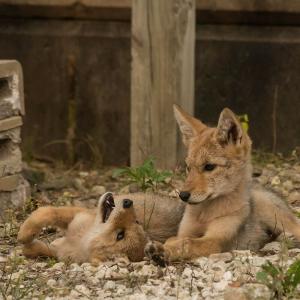
APPEARANCE: What does a coyote look like?
The coyote is a medium-sized member of the dog
family that includes wolves and foxes.
Overall
Appearance:
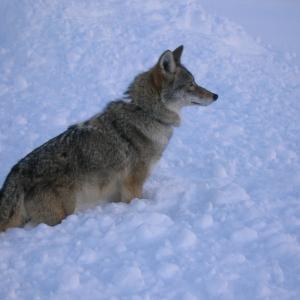
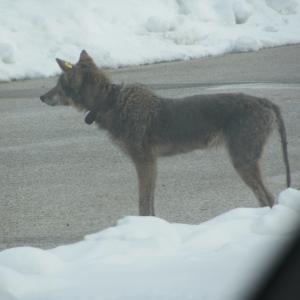
With its pointed ears, slender muzzle, and drooping
bushy tail, the coyote often resembles a German
shepherd or collie
Coloration:
Coyotes are usually a grayish brown with reddish
tinges behind the ears and around the face, but
coloration can vary from a silver-gray to black. The
tail usually has a black tip.
|
Profile of a coyote, with long snout and large
upright ears. |

Eyes:
Eyes are a striking yellow, with large dark pupils,
rather than brown like many dogs.

Weight:
Most adults weigh between 25-35 lbs. A few big ones
weigh in the 42-43 lbs. range.
Coyote-Dog Hybrids:
People often speculate as to the frequency of
coyote-dog hybrids, or coydogs, in urban settings.
Coyotes and dogs are related, and they are
biologically capable of producing hybrid litters.
Coydogs have been raised in captivity.
Genetic surveys of coyotes have rarely documented
evidence of dogs in the genetic makeup of coyotes,
despite domestic dogs and coyotes sharing the
continent for the past 9,000 years.
Although it is possible, coydogs in urban settings
are unlikely because:
·
Coyotes are highly seasonal breeders; dogs are not.
·
Coydog females have a shifted estrus cycle that does
not coincide with the coyote period.
·
Domestic dog and coydog males do not tend to
litters, whereas male coyotes do.
·
Coydogs may have lower fertility than either
domestic dogs or coyotes.
HISTORICAL RANGE & CURRENT DISTRIBUTION: Where do
coyotes occur?

Current
Distribution:
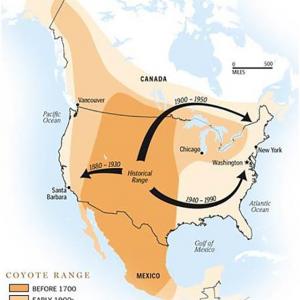
Coyotes are native to North America and currently
occur throughout most of North America (see Figure 1).
In addition to occurring in natural areas,
coyotes are also found in a range of human-populated
areas, including rural farms, suburbs and cities
(see
Habitat
for more information).
Fig. 1.-- Image provided by Canadian Geographic
Historical Distribution:
Although coyotes have a current distribution that
spans across most of North and Central America,
their historical range prior to 1700 was restricted
to the prairies and desert areas of
Mexico
and central North America
(see Figure 2).
Since
the 1700s, coyotes have dramatically expanded their
range across North America (see Figure 3) and now
are found in an increasing number of cities in the
United States and Canada.
This expansion in distribution is unique as
other large carnivore populations, such as wolves
and bears, were extirpated from many portions of the
United States,
leading to the absence of large carnivores in most
urban landscapes.
Fig. 2.—Historical
distribution of coyotes prior to
1700.
The emergence of coyotes in urban systems can have
important ecological implications, such as through
their role as an apex carnivore and subsequent
effects on prey (see
Relationships
with Other Animals for more information).

Fig. 3.—
Progression of coyote range
expansion throughout North
America and Mexico.
DIET: What do urban coyotes eat?
Many people believe that urban coyotes primarily eat
garbage and pets.
Although coyotes are predators, they are also
opportunistic and shift their diets to take
advantage of the most available prey.
Coyotes are generally scavengers and
predators of small prey, but can shift to large prey
occasionally.
Paul
Morey analyzed scat contents at different locations
within our study area.
He analyzed 1,429 scats and found that diet
items varied across space and time, which reflects
the flexible food habits of coyotes.
The most common food items were small rodents (42
percent), fruit (23 percent), deer (22 percent), and
rabbit (18 percent). (Scats often have more than one
diet item; therefore, frequencies do not necessarily
add up to 100 percent.)
Apparently the majority of coyotes in our
study area do not, in fact, rely on pets or garbage
for their diets.
The most food items were small rodents (42 percent),
fruit (23 percent), deer (22 percent), and rabbit
(18 percent). (Scats often have more than one diet
item; therefore, frequencies do not necessarily add
up to 100 percent.)
Apparently the majority of coyotes in our
study area do not, in fact, rely on pets or garbage
for their diets.
BREEDING: When do coyotes have young?
Mating and Gestation: In most years, coyotes
typically mate in February. Only the alpha pair
mates in a pack, but subordinates may help raise the
young.
In April, after a 62- to 65-day gestation period,
the female will begin looking for existing dens or
dig one herself.
The Den:
During mating and gestation is the only time coyotes
will voluntarily use a den; otherwise, coyotes
usually sleep above ground in the open or in cover.

Dens
usually consist of a hollowed out tree stump, rock
outcrop, or existing burrow made by raccoons, skunks
or other medium-sized carnivores.
Coyotes will also build dens from scratch by digging
a hole. They usually prefer some protective cover at
the den, such as bushes or trees, and some type of
slope for drainage.
It is not uncommon for mothers to move their young
from den to den to keep them protected or to re-use
the same den in multiple years. Some coyotes select
secluded areas for their dens, whereas others in
more urbanized areas have less selection and may use
dens near buildings or roads.

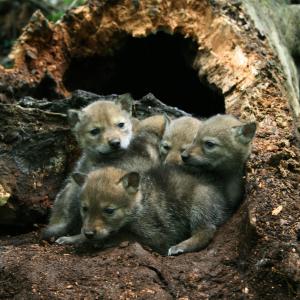
Pup in den from the Big Hill
pack.
The Litter:
Litter sizes often range from four to seven pups,
depending on food availability and the density of
the surrounding coyote population.
Some litters can be bigger; the largest
litter we have found was 11 pups taken from one den.

Coyotes
have the ability to adjust their litter sizes based
on food abundance and population density.
It is difficult for us to get reliable
estimates of litter sizes in urban areas, but our
results suggests that litter sizes are larger than
average, indicating an abundant food supply.
Pups stay in the den for about six weeks, and
then begin traveling short distances with adults.
By the end of summer, pups are spending some
time away from parents and attempting to hunt on
their own or with siblings.
LIFE EXPECTANCY: How long do coyotes live?

In
captivity, coyotes can live 13 to 15 years, but in
the wild, most die before they reach three years of
age. In
our study, we found that coyotes generally have a 60
percent chance of surviving one year.
See
Coyote
Mortality for more.
COYOTE SOCIAL LIFE
Coyotes typically have a highly organized social
system, even in urban areas. This consists of packs,
or groups of coyotes that apparently defend
territories from other coyotes.
In Cook
County, we have identified
coyotes that live in packs (pack coyotes) as well as
coyotes that live and travel alone (solitary
coyotes).
See
Territories
& Home Ranges and
Coyote Packs
to learn more about social behavior found among
urban coyotes in Cook County.
|